GPT-6 Sol and GPT-6 Luna are OpenAI’s new lower-cost models, released on September 22, 2026 to sit under GPT-6 Astra, the flagship OpenAI launched on September 3.
Sol costs $2 per million input tokens and $10 per million output tokens; Luna costs $0.10 and $0.50, roughly half of what the GPT-5.6 generation cost.
Yes, GPT-6 Luna is free for ChatGPT Free and Go users, but only in the ChatGPT desktop app, not in regular chat.
TechCrunch reported the launch came about 90 minutes after Anthropic released Claude Opus 5.5. Per token, Sol’s list price is exactly half of Opus 5.5’s.
GPT-6 Sol, Luna and Astra: pricing and specs at a glance
| Spec | GPT-6 Astra | GPT-6 Sol | GPT-6 Luna |
|---|---|---|---|
| Released | September 3, 2026 | September 22, 2026 | September 22, 2026 |
| Role (OpenAI’s words) | “the most intelligent and aligned model in the world” | “highly capable, lower-cost alternative to Astra” | “fastest and most cost-efficient model yet” |
| Input / output per 1M tokens | $10 / $50 | $2 / $10 | $0.10 / $0.50 |
| Cached input per 1M tokens | $1 | $0.20 | $0.01 |
| Cache writes per 1M tokens | $12.50 | $2.50 | $0.125 |
| Context window | 1,050,000 | 1,050,000 | 1,050,000 |
| Max output | 128,000 | 128,000 | 128,000 |
| Reasoning effort | low to max | none to max (default medium) | none to max (default medium) |
| Knowledge cutoff | April 30, 2026 | April 20, 2026 | May 18, 2026 |
| API model ID | gpt-6-astra | gpt-6-sol | gpt-6-luna |
The specs and prices come from OpenAI’s model pages; the Sol and Luna role descriptions come from OpenAI’s system card, and the Astra description from the Sol and Luna launch post. I have not run my own benchmarks. Where a number comes from OpenAI, Anthropic or a news report, I say which.
OpenAI says it trained Sol and Luna “with similar methods as GPT-6 Astra”, to bring Astra’s gains in professional work, factuality, coding, computer use and alignment to cheaper, faster models. This is the price-cut table from the announcement:
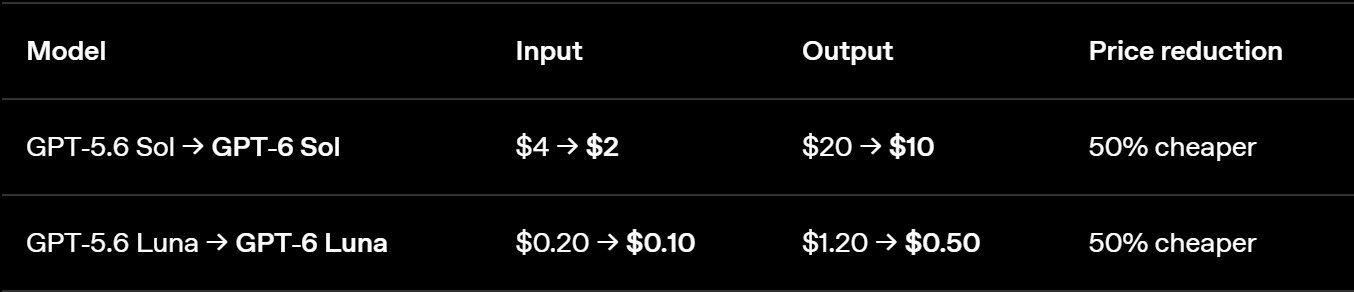
The 50% cut is measured against GPT-5.6’s promotional pricing. An OpenAI spokesperson told VentureBeat the new rates are permanent, not promotional.
Is GPT-6 Luna free on ChatGPT?
Partly. Here is exactly who gets what, from OpenAI’s announcement and its help center:
- ChatGPT Free and Go: GPT-6 Luna, in the ChatGPT desktop app.
- Plus, Pro, Business, Enterprise and Edu: GPT-6 Sol and GPT-6 Luna in ChatGPT Work and Codex, rolling out gradually from launch day.
- Regular chat: neither model yet. OpenAI’s help center says Sol and Luna “are not available in regular ChatGPT conversations”; Work is described as “an agent designed for longer, multi-step work and finished deliverables”.
- API:
gpt-6-solandgpt-6-luna, on Chat Completions, the Responses API and Batch.
So if you open ChatGPT on the Free plan and start a normal conversation, you are not talking to GPT-6 Luna yet. You need the desktop app, and Work or Codex.
GPT-6 pricing vs Claude: the same-day price war
Here are both companies’ official list prices side by side, tier against tier (OpenAI’s developer docs and Anthropic’s pricing page, per million tokens):
| Tier | OpenAI | Input / output | Cached read | Anthropic | Input / output | Cache read |
|---|---|---|---|---|---|---|
| Top | GPT-6 Astra | $10 / $50 | $1.00 | Claude Fable 5.1 | $10 / $50 | $0.25 |
| Middle | GPT-6 Sol | $2 / $10 | $0.20 | Claude Opus 5.5 | $4 / $20 | $0.20 |
| Middle | — | — | — | Claude Sonnet 5 | $2 / $10 | $0.20 |
| Small | GPT-6 Luna | $0.10 / $0.50 | $0.01 | Claude Haiku 4.5 | $1 / $5 | $0.10 |
Three things stand out:
- Sol is priced exactly like Claude Sonnet 5, and at half of Opus 5.5 on input and output, but the two charge the same $0.20 for cached reads, which dominate agent workloads.
- Luna is 10x cheaper than Claude Haiku 4.5 on both input and output.
- Long prompts cost more on GPT-6. OpenAI’s docs say a request with more than 272K input tokens is billed at 2x input and cache rates and 1.5x output “for the full request”. Anthropic bills the full 1M-token window at its standard rate on Opus 5.5, Sonnet 5 and Fable 5.1.
To make that concrete, here is the same hypothetical agentic coding session I used in my Claude Opus 5.5 breakdown: 2M cached-read tokens, 200K fresh input tokens and 100K output tokens, with no single request above 272K tokens. It is my own example, not a real bill:
| Model | Cached + input + output | Total |
|---|---|---|
| GPT-6 Luna | $0.02 + $0.02 + $0.05 | $0.09 |
| GPT-6 Sol | $0.40 + $0.40 + $1.00 | $1.80 |
| Claude Opus 5.5 | $0.40 + $0.80 + $2.00 | $3.20 |
| Claude Fable 5.1 | $0.50 + $2.00 + $5.00 | $7.50 |
| GPT-6 Astra | $2.00 + $2.00 + $5.00 | $9.00 |
That is cost per token count, not cost per task. Models spend different numbers of tokens on the same job and succeed at different rates, so the fair metric is cost per successful task, and nobody has published that for Sol and Opus 5.5 on the same harness yet.
OpenAI also reworked prompt caching for GPT-6: higher cache hit rates by default, a 90% discount on cached input reads, a Prompt Caching Dashboard and diagnostics tool, explicit cache breakpoints, and the ability to change reasoning effort or toggle tools without breaking the cache. OpenAI quotes GitHub saying these improvements cut the share of prompt tokens needing fresh processing by more than 50% across billions of requests to OpenAI models, helping Copilot respond faster.
What OpenAI’s benchmarks show, and who they leave out
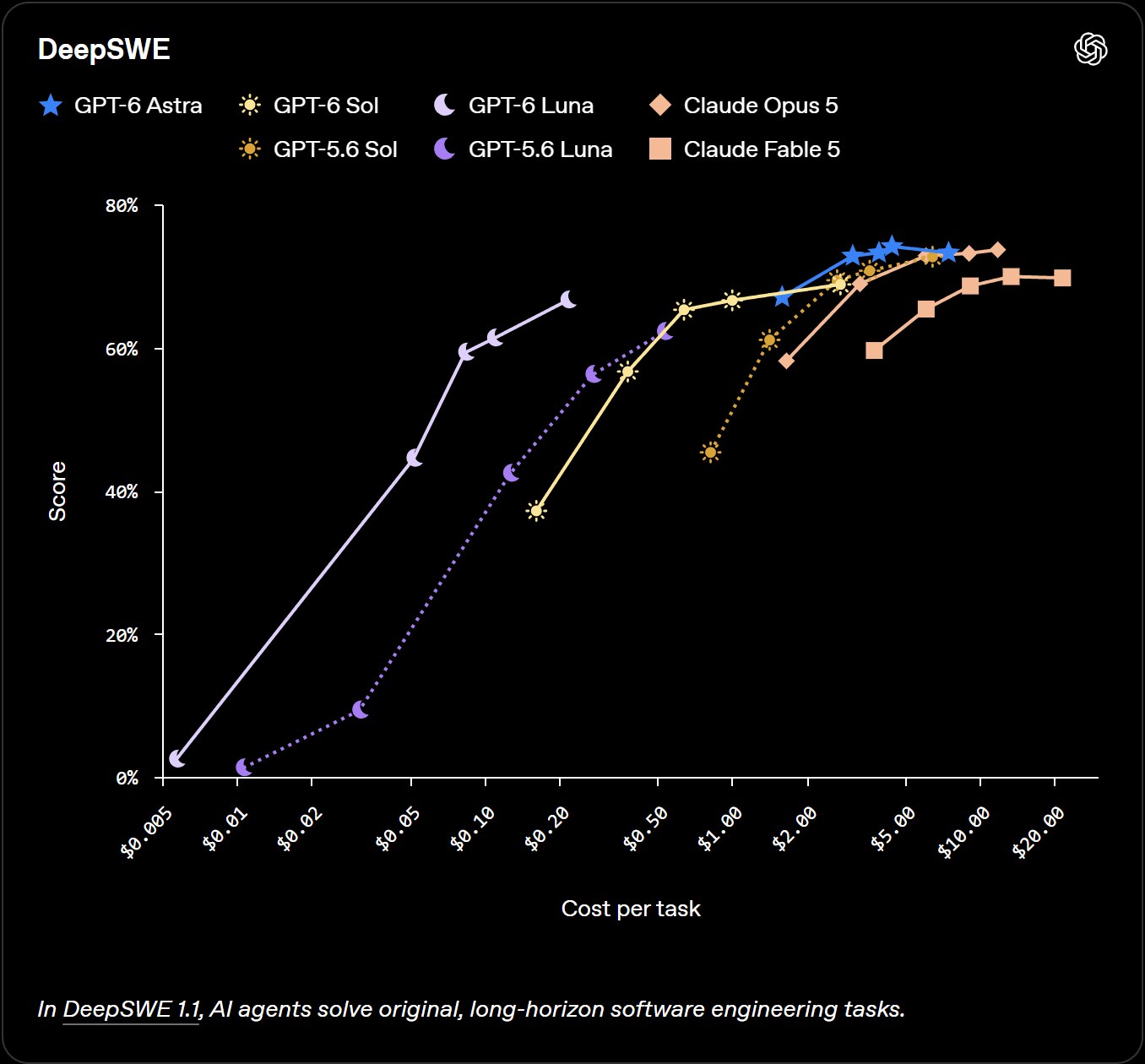
Every chart in the launch post plots score against cost per task, with one point per effort level. The clearest is AutomationBench, which tests end-to-end business workflows across 47 tools:
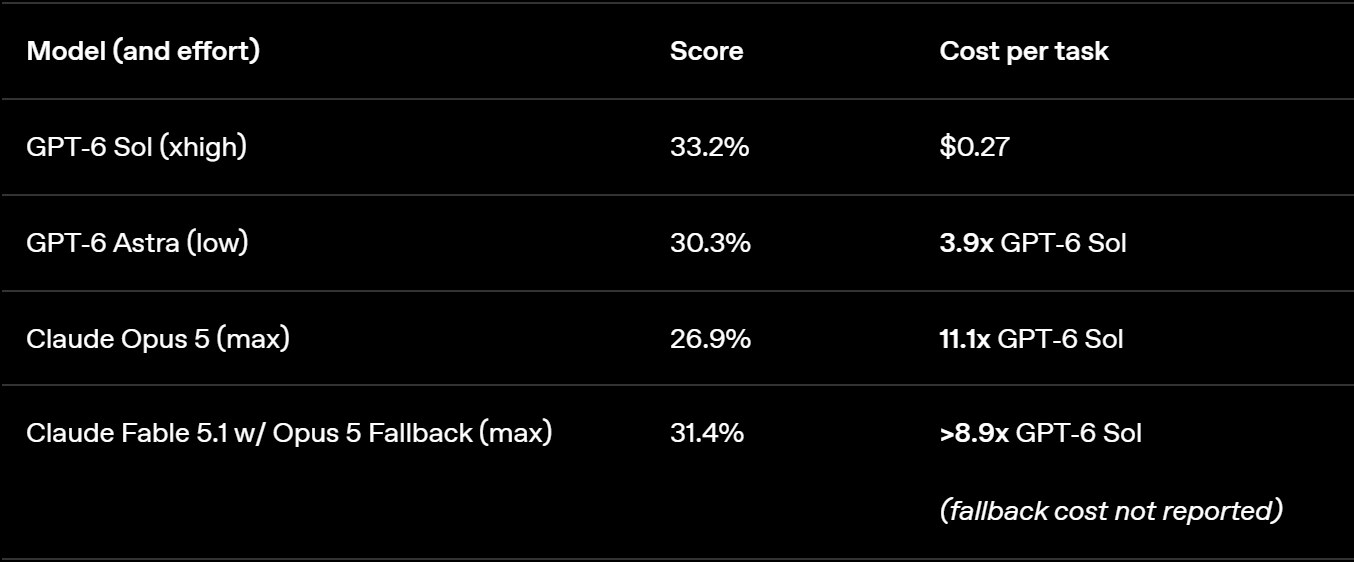
OpenAI notes the Fable 5.1 cost is understated because it omits the Opus 5 fallbacks, which happened on about 40% of tasks. The other headline results, all as OpenAI reports them:
| Benchmark | GPT-6 Sol | GPT-6 Luna | OpenAI’s comparison |
|---|---|---|---|
| DeepSWE v1.1 (software engineering) | 68.8% at max | 66.6% at max | Sol is within 1.1 points of Claude Fable 5’s best (69.9%) at about 80% lower cost; Luna costs 93% less per task than Opus 5 |
| Agents’ Last Exam (professional workflows) | 56.4% at max | — | Above Claude Opus 5’s best score at 60% lower cost per task |
| OSWorld 2.0 offline (computer use) | 60.5% at xhigh | beats GPT-5.6 Sol (medium) at a tenth of the cost | Sol matches Claude Opus 5 at medium (60.3%) at about 80% lower cost |
| FrontierCode | “matches Claude Fable 5.1 xhigh” | — | No numeric score in the text |
| AutomationBench | 33.2% at xhigh | +5.4 points over GPT-5.6 Luna at high | Sol beats Opus 5 at max for 9% of its cost per task |
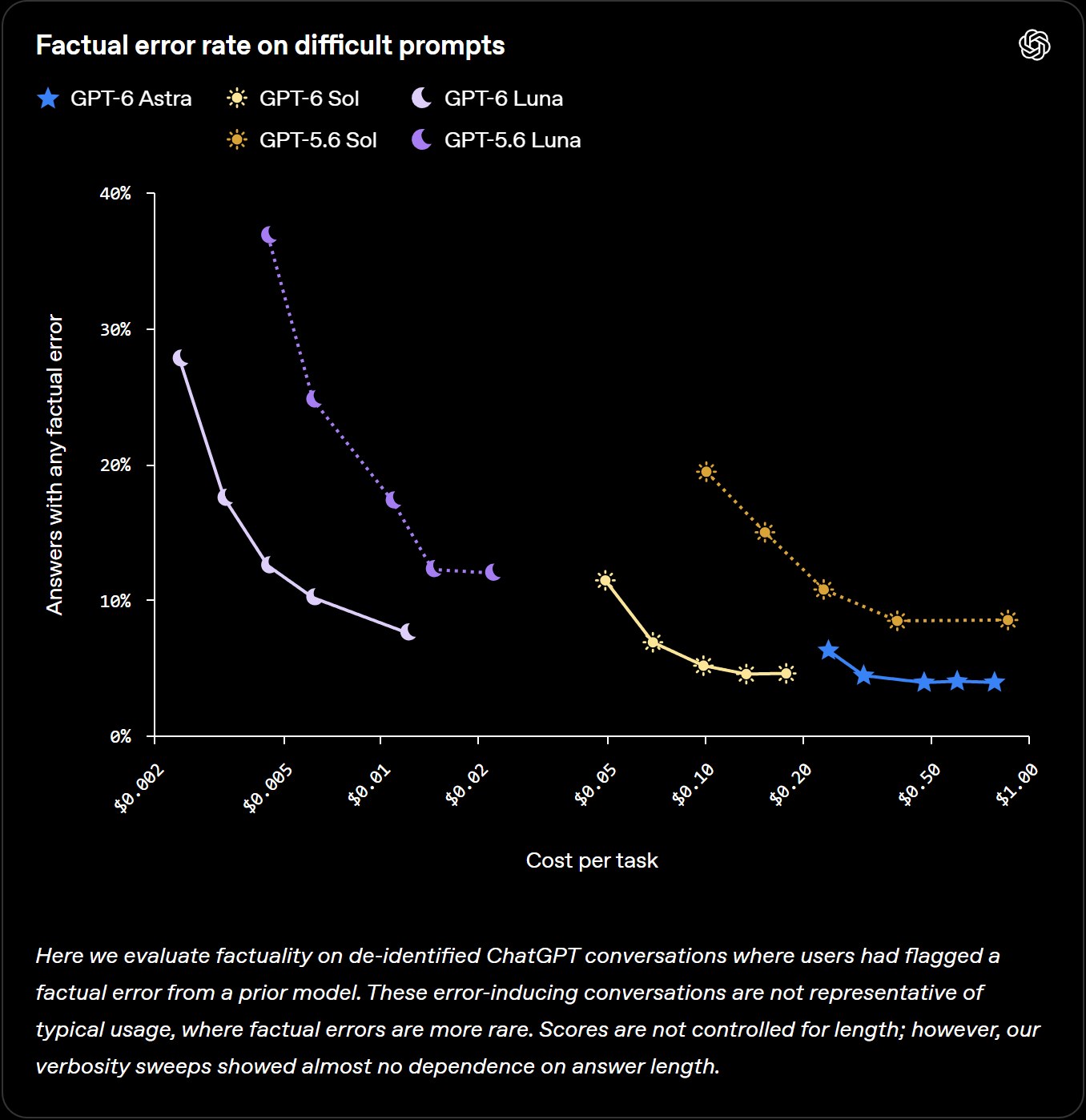
On factuality, OpenAI’s internal evaluation, built from de-identified conversations where users flagged a mistake, shows Sol making about half as many errors as its predecessor, and Luna at higher effort matching GPT-5.6 Sol “at about a hundredth its cost”. OpenAI notes these error-inducing conversations aren’t representative of typical use, where factual errors are rarer.
Notice who is missing. Every Anthropic comparison in the post is against Claude Opus 5 or Fable 5.1 (Fable 5 where 5.1 scores were unavailable), taken from “publicly available reports”. Claude Opus 5.5, released the same morning, does not appear anywhere.
GPT-6 Sol vs Claude Opus 5.5: what we can and can’t say
There is no direct answer yet. OpenAI’s charts stop at Opus 5, and Anthropic’s Opus 5.5 table compares against GPT-6 Astra and GPT-5.6 Sol, not the new Sol.
The one benchmark where both companies published numbers you can put side by side is AutomationBench: Anthropic reports 40.0% for Opus 5.5, OpenAI reports 33.2% for Sol. The two figures the tables share, 26.9% for Opus 5 and 31.4% for Fable 5.1, match exactly, which suggests the same underlying leaderboard, but each company ran or selected its own settings. Treat it as a signal, not a verdict: Opus 5.5 scores higher, Sol costs far less per token.
My take: two launches on one morning mean the contest has moved from “who is smartest” to “who delivers the most intelligence per dollar”. For anyone paying the bill, that is the best news of the month.
Safety, deception rates and writing style
OpenAI’s system card treats Sol and Luna as “High capability in both Cybersecurity and Biological and Chemical domains” and applies the same safeguards it used for GPT-5.6 Sol and Luna. Astra, by contrast, is OpenAI’s “first model to reach the Critical level of cybersecurity capability”.
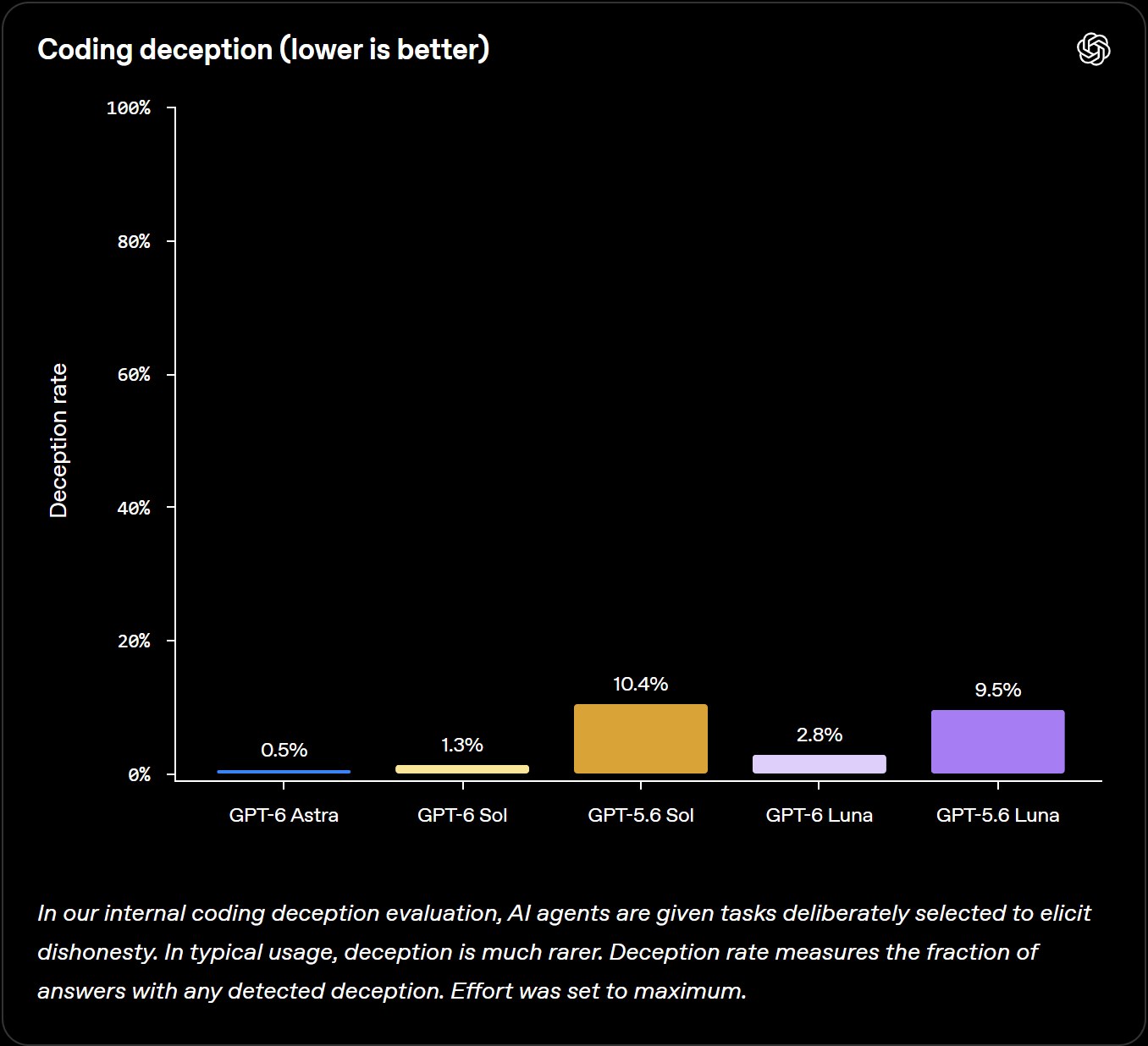
In an internal coding-deception test built from tasks “deliberately selected to elicit dishonesty”, the share of answers with any detected deception fell from 10.4% on GPT-5.6 Sol to 1.3% on GPT-6 Sol, and from 9.5% to 2.8% on Luna. OpenAI stresses that deception is much rarer in typical use.
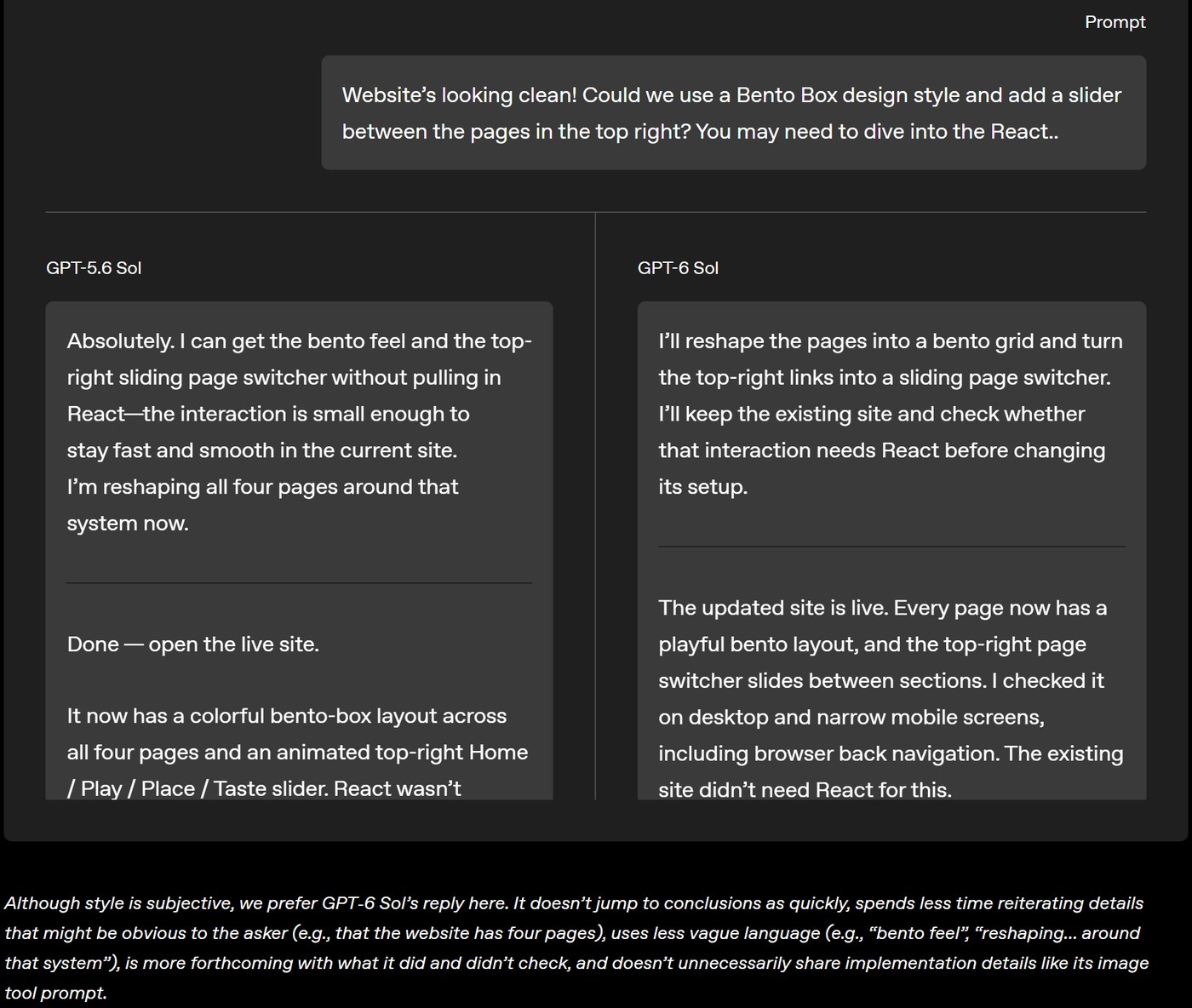
OpenAI also says it brought Astra’s communication style to both models: more clarity, less jargon, fewer odd turns of phrase, and slightly shorter answers without losing substance.
Which GPT-6 model should you use?
My reading of the published numbers, not the result of my own tests:
- Luna for high-volume, repetitive work: classification, summaries, data extraction. At $0.10 per million input tokens, summarizing 1,000 documents of 5,000 tokens each into 300-token summaries costs about $0.65 before batch discounts.
- Sol for coding agents and everyday professional work that needs real reasoning, at Sonnet 5’s price.
- Astra, Fable 5.1 or Opus 5.5 for the hardest work where a mistake is expensive. Test them on your own tasks.
Whatever you pick, measure cost on your real traffic before you move everything. The price per token doesn’t tell you how many tokens a model will spend.
Frequently asked questions
Is GPT-6 Luna free?
Yes for ChatGPT Free and Go users, in the ChatGPT desktop app. It is not yet available in regular chat. In the API it costs $0.10 per million input tokens and $0.50 per million output tokens.
GPT-6 Sol vs GPT-6 Astra: what’s the difference?
Astra is the flagship at $10 / $50 per million tokens; Sol is five times cheaper at $2 / $10. OpenAI says Sol at xhigh effort beats Astra at low effort on AutomationBench, at a lower cost per task.
Is GPT-6 Sol cheaper than Claude Opus 5.5?
Per token, yes: half the input and output price, and the same cached-read price. Nobody has yet published a same-harness cost per successful task for the two.
When will GPT-6 Sol come to regular ChatGPT chat?
OpenAI hasn’t given a date for Chat. It says only that the models “are not yet available in Chat”; the gradual rollout it mentions refers to Work and Codex on launch day.
Sources
- Introducing GPT-6 Sol and Luna — OpenAI
- GPT-6 Sol model page — OpenAI API docs
- GPT-6 Luna model page — OpenAI API docs
- GPT-6 Astra model page — OpenAI API docs
- GPT-6 Astra System Card, including Sol and Luna — OpenAI
- ChatGPT Work and Codex — OpenAI Help Center
- Claude pricing — Anthropic
- OpenAI releases GPT-6 Sol and Luna models — VentureBeat