Claude Opus 5.5 is Anthropic’s newest model, released on September 22, 2026 as the first model in the Claude 5.5 family.
Anthropic says it performs at the level of Claude Fable 5.1 on most work while costing about 40% less to run than Opus 5 on typical workloads.
It costs $4 per million input tokens and $20 per million output tokens, has a 1M-token context window, and is available now as claude-opus-5-5 on the Claude API, Amazon Bedrock, Claude Platform on AWS, Google Cloud and Microsoft Foundry.
Before you swap the model ID, know that four API changes can break code that worked on Opus 5, and that most cybersecurity tasks now fall back to Opus 4.8.
Claude Opus 5.5 at a glance
| Spec | Claude Opus 5.5 |
|---|---|
| Released | September 22, 2026 |
| API model ID | claude-opus-5-5 (Bedrock: anthropic.claude-opus-5-5) |
| Context window | 1M tokens |
| Max output | 128K tokens (300K on the Batch API with a beta header) |
| Input / output price | $4 / $20 per million tokens |
| Cache reads | $0.20 per million tokens |
| Thinking | Adaptive, always on |
| Default effort | medium (Opus 5 defaulted to high) |
| Reliable knowledge cutoff | June 2026 |
| Retirement | Not sooner than September 22, 2027 |
All of the above comes from Anthropic’s announcement and its model documentation. I have not run my own benchmarks; where a number comes from Anthropic, a customer, or OpenAI, I say so.
What did Anthropic actually announce?
The announcement calls Opus 5.5 “the new leading model”. In my reading that is an unusual position for an Opus: in Anthropic’s current lineup, Opus sits between Sonnet and Fable on price, yet this one catches Fable 5.1, the top model Anthropic released on September 1. It is also the company’s first release since it called for “pacing the frontier”, and it was tested before launch by outside evaluators including Frontier Design and METR.
The early-tester examples show the kind of work it is aimed at. One tester completed a 680,000-line code migration in less than a day, work Anthropic says would have taken an engineering team weeks. In Anthropic’s own test, asked to cut load times across every page of a web app, Opus 5.5 succeeded 39 times out of 40, while Opus 5 made smaller improvements that also changed the app’s behavior. In another internal test, Anthropic had Opus 5.5 and Fable 5.1 translate HAProxy from C to Rust: both rewrites passed nearly all of HAProxy’s own regression tests, but Opus 5.5 finished in 9.5 hours against 12 for Fable 5.1, at 51% lower cost.
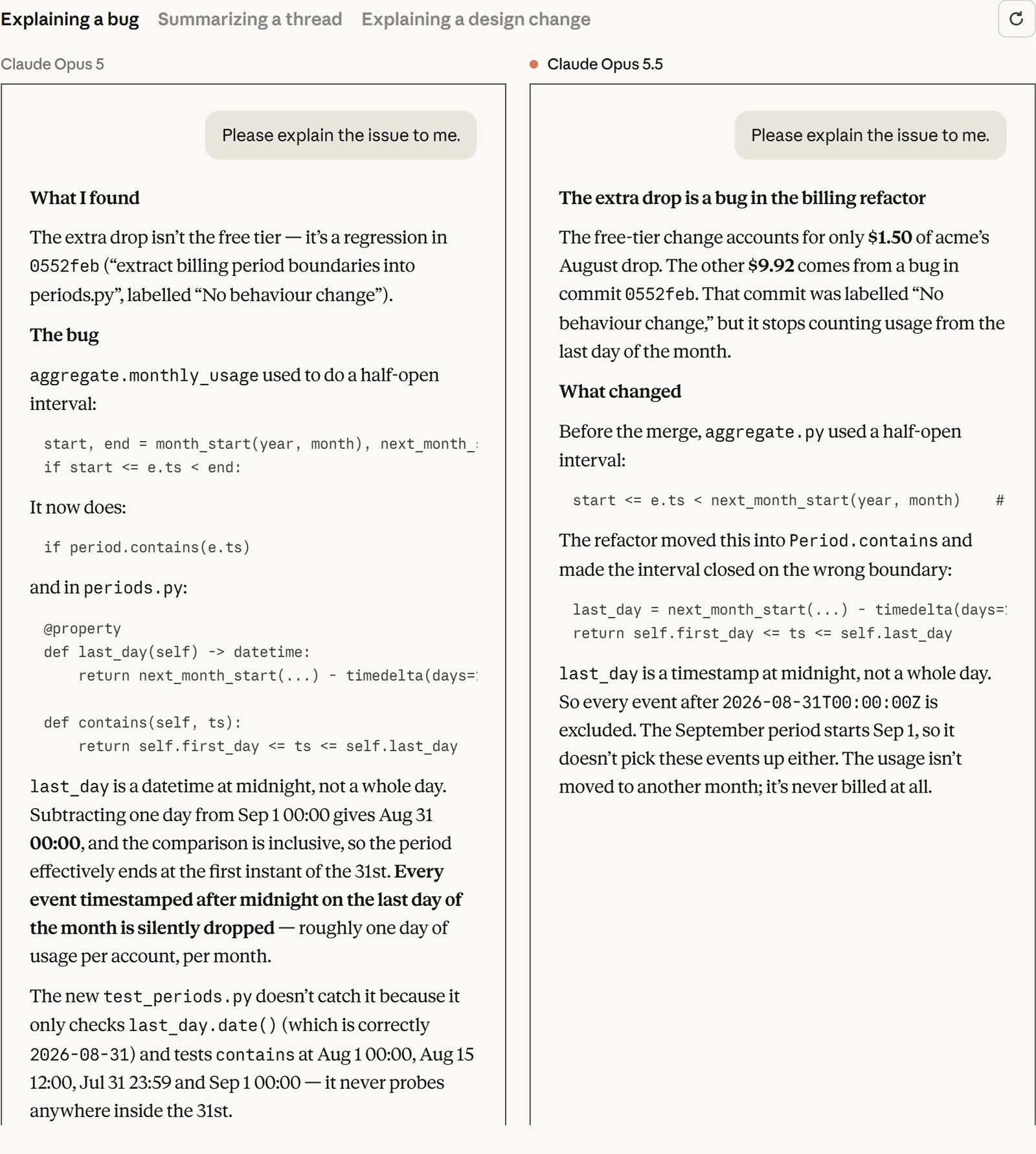
The change most users will notice first is the writing. Anthropic says writing was one of the most common areas of feedback it heard about Opus 5, and that Opus 5.5 puts the most important information up front, is less likely to use jargon, and follows the writing rules you give it. It published a side-by-side of both models answering the same bug question:
Claude Sonnet 5.5 and Claude Haiku 5.5 are due “in the coming weeks”, with many of the same improvements.
Claude Opus 5.5 benchmarks: where it leads, and the two tests it loses
This is Anthropic’s official comparison table:
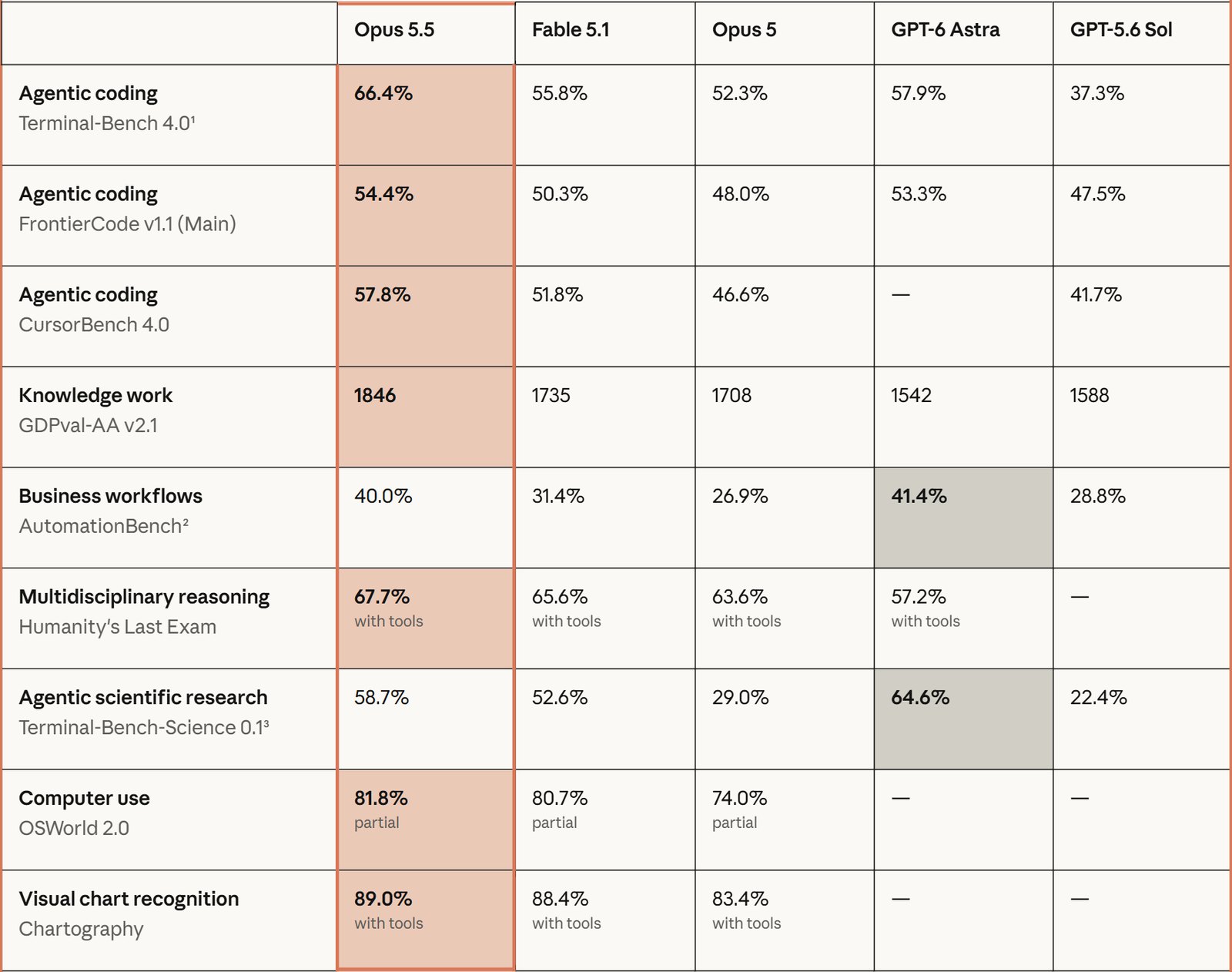
The same numbers as text:
| Benchmark | Opus 5.5 | Fable 5.1 | Opus 5 | GPT-6 Astra | GPT-5.6 Sol |
|---|---|---|---|---|---|
| Terminal-Bench 4.0 (agentic coding) | 66.4% | 55.8% | 52.3% | 57.9% | 37.3% |
| FrontierCode v1.1 Main (agentic coding) | 54.4% | 50.3% | 48.0% | 53.3% | 47.5% |
| CursorBench 4.0 (agentic coding) | 57.8% | 51.8% | 46.6% | — | 41.7% |
| GDPval-AA v2.1 (knowledge work, Elo) | 1846 | 1735 | 1708 | 1542 | 1588 |
| AutomationBench (business workflows) | 40.0% | 31.4% | 26.9% | 41.4% | 28.8% |
| Humanity’s Last Exam, with tools | 67.7% | 65.6% | 63.6% | 57.2% | — |
| Terminal-Bench-Science 0.1 | 58.7% | 52.6% | 29.0% | 64.6% | 22.4% |
| OSWorld 2.0 (computer use, partial) | 81.8% | 80.7% | 74.0% | — | — |
| Chartography, with tools | 89.0% | 88.4% | 83.4% | — | — |
Opus 5.5 beats Opus 5 and Fable 5.1 on every row. It does not beat GPT-6 Astra everywhere: Astra leads on AutomationBench (41.4% vs 40.0%) and on agentic scientific research, Terminal-Bench-Science (64.6% vs 58.7%).
Four footnotes change how to read the table:
- These are peak scores. Unless noted, Opus 5.5 ran with adaptive thinking at max effort; on Terminal-Bench 4.0 the figures are Opus 5.5 at xhigh and GPT-6 Astra at high, each model’s highest score. Your default-effort results will be lower.
- Safeguards were on. Opus 5.5 was evaluated with its production safeguards enabled. When they intervened, Opus 4.8 completed the cybersecurity tasks and Opus 5 completed the biology and frontier-LLM-development tasks. Anthropic says this “likely reduces” Opus 5.5’s scores.
- Some competitor numbers are OpenAI’s. GPT-6 Astra and GPT-5.6 Sol figures on Terminal-Bench 4.0, and Astra’s on Terminal-Bench-Science, are as reported by OpenAI. AutomationBench was run by Zapier, and there safeguard interventions counted as failures.
- Anthropic itself discounts the margins. It writes that at this level benchmark margins are “a less reliable guide to real-world differences”, and that in its own use the gap to Fable 5.1 is narrower than the scores suggest.
How much does Claude Opus 5.5 cost? Pricing and real cost math
The clearest advantage, in Anthropic’s words, is efficiency. The model needs less compute to serve, and the price follows:
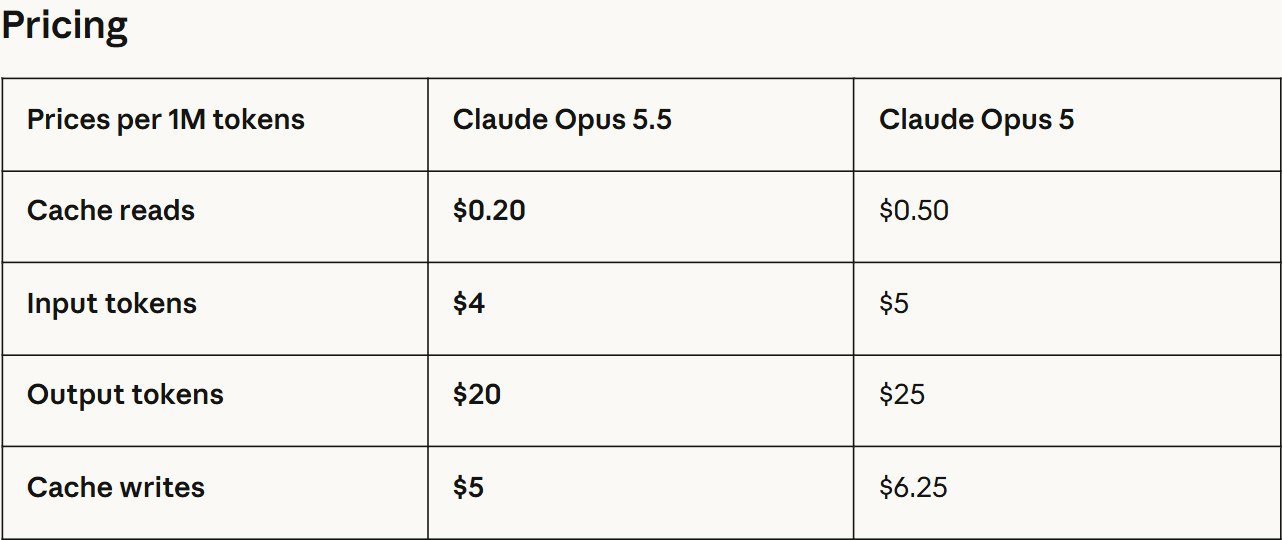
| Per 1M tokens | Opus 5.5 | Opus 5 | Change |
|---|---|---|---|
| Cache reads | $0.20 | $0.50 | -60% |
| Input | $4 | $5 | -20% |
| Output | $20 | $25 | -20% |
| Cache writes (5 min) | $5 | $6.25 | -20% |
| Cache writes (1 hour) | $8 | $10 | -20% |
| Batch API input / output | $2 / $10 | $2.50 / $12.50 | -20% |
| Fast mode input / output | $8 / $40 | $10 / $50 | -20% |
For context, Anthropic’s models overview lists Fable 5.1 at $10 / $50, so per token Opus 5.5 is 60% cheaper than the model it matches. Fast mode, which gives up to 2.5x faster output, is in research preview on the first-party Claude API (Anthropic also offers it in Claude Code), not on Amazon Bedrock, Claude Platform on AWS, Google Cloud or Microsoft Foundry. The full 1M context window is billed at the standard rate.
Why does Anthropic say 40% cheaper when the per-token cut is 20%? Because the saving has two parts: a lower price per token and fewer tokens per task. Here is a hypothetical agentic coding session I made up to show the first part, not a real customer bill: 2M cache-read tokens, 200K fresh input tokens and 100K output tokens.
- Opus 5: 2 × $0.50 + 0.2 × $5 + 0.1 × $25 = $1.00 + $1.00 + $2.50 = $4.50
- Opus 5.5: 2 × $0.20 + 0.2 × $4 + 0.1 × $20 = $0.40 + $0.80 + $2.00 = $3.20
That is about 29% less for the identical token count, mostly from the cheaper cache reads that dominate agent loops. The rest of the gap to 40% comes from Opus 5.5 finishing the same task with fewer tokens. Customer reports on Anthropic’s page point the same way: GitHub says it solved more terminal tasks than Opus 5 in VS Code “in less than half the steps”, and Box says it used “a third of the tokens Opus 5 did”.
Anthropic’s cost charts put effort level on each point and cost per attempt on the horizontal axis:
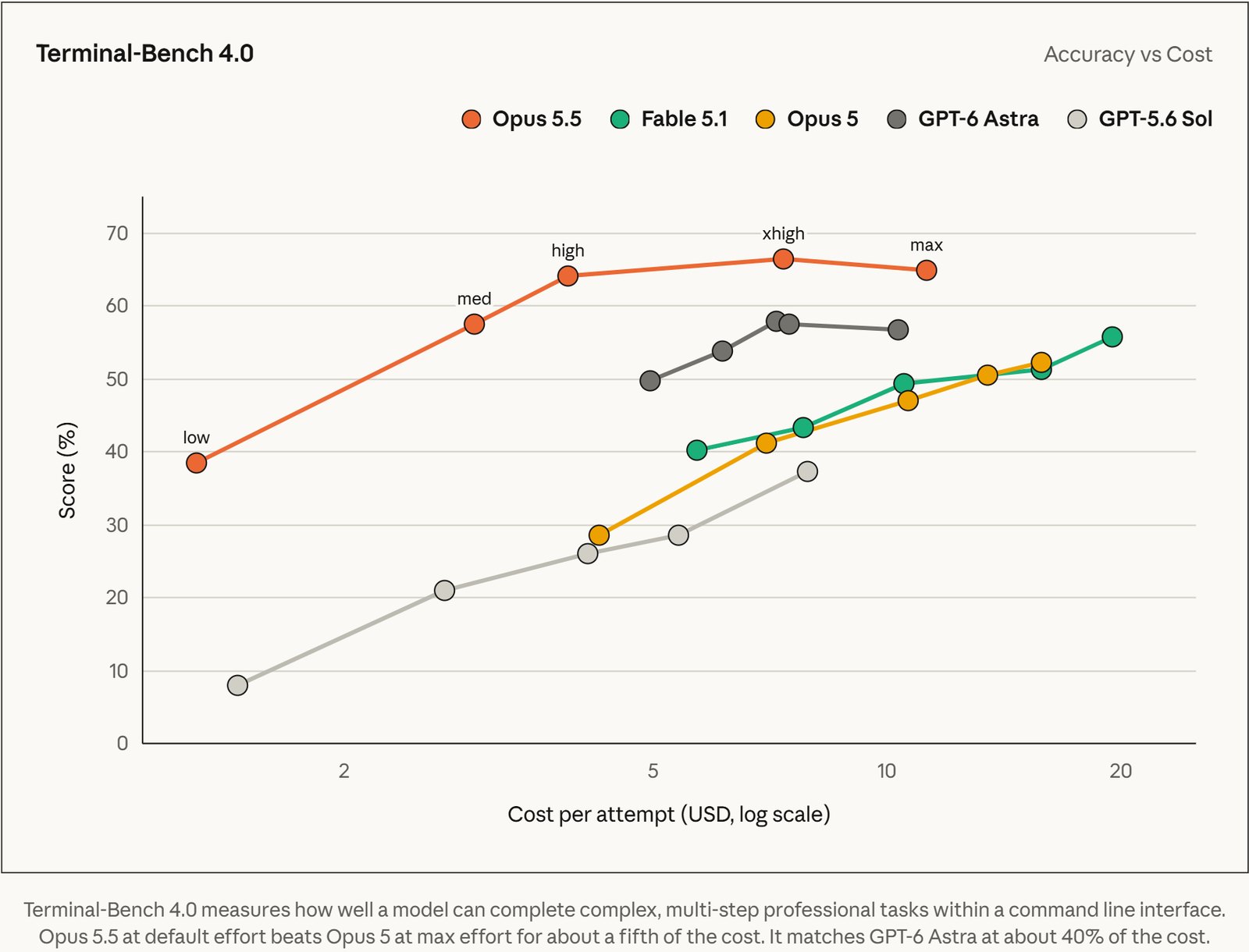
On Terminal-Bench 4.0, Anthropic says Opus 5.5 at default effort beats Opus 5 at max effort for about a fifth of the cost, and matches GPT-6 Astra at about 40% of the cost.
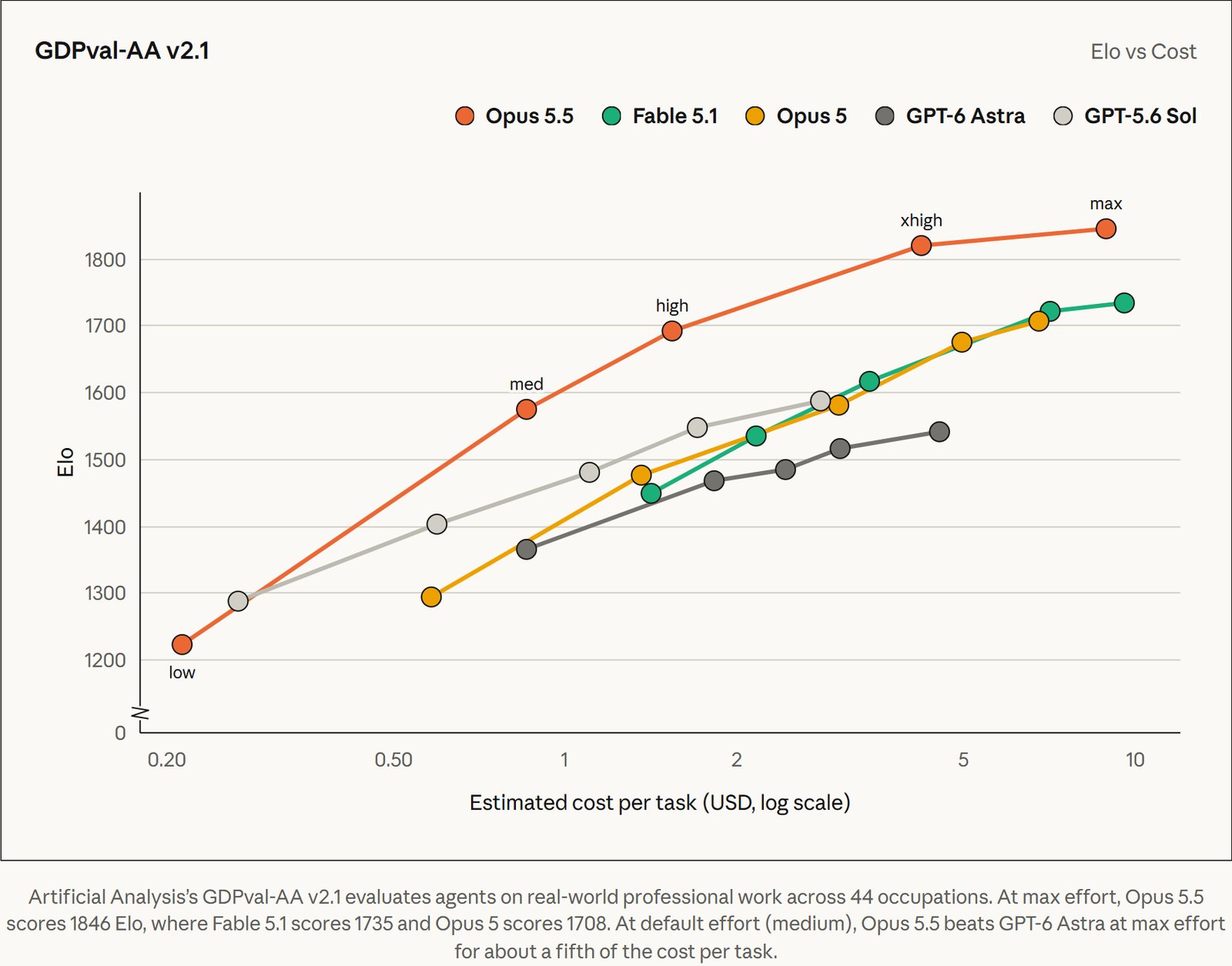
On GDPval-AA v2.1, which covers real professional work across 44 occupations, Opus 5.5 scores 1846 Elo at max effort, and at its default medium effort beats GPT-6 Astra at max effort for about a fifth of the cost per task.
Subscribers get something too: Anthropic is raising the five-hour usage limits on Pro, Max, Team and seat-based Enterprise plans, and giving subscription users a rate-limit reset they can save and use whenever they choose.
Claude Opus 5.5 breaking changes: what to fix before you switch
Changing the model string is not always enough. Anthropic’s “What’s new” page lists four breaking changes for code already running on Opus 5; most of them return a 400 invalid_request_error:
- Thinking can’t be disabled.
thinking: {"type": "disabled"}and manualbudget_tokensare rejected. Omit the field (or send{"type": "adaptive"}) and use the effort parameter to control depth and cost. - Forced tool use is gone.
tool_choiceofanyortoolis rejected. Keepauto, setstrict: trueon the tool for schema-valid output, and say in the prompt when the tool applies. - Thinking blocks are tied to the model and the conversation. For every account, Opus 5.5 cannot read thinking blocks from Fable or Mythos models; the API silently drops unreadable blocks, so a conversation that switches models loses the earlier reasoning without an error. For accounts created on or after August 31, 2026, replaying a thinking block after changing anything before it (system prompt, tools or an earlier message) also fails with a 400. Keep conversations append-only and change instructions with mid-conversation system messages. Anthropic calls this “preserved thinking”.
- The old computer use tool is rejected on the Claude API and Google Cloud. Move from
computer_20251124to thecomputer_toolset_20260801toolset. On Amazon Bedrock the old tool still works.
A minimal before and after in Python:
# Worked on Opus 5, fails on Opus 5.5
client.messages.create(
    model="claude-opus-5",
    thinking={"type": "disabled"},
    tool_choice={"type": "tool", "name": "extract_invoice"},
    ...
)

# Opus 5.5
client.messages.create(
    model="claude-opus-5-5",
    output_config={"effort": "low"},  # replaces disabled thinking
    tool_choice={"type": "auto"},     # plus "strict": True on the tool definition
    ...
)
Two more changes fail silently, which makes them worse. The default effort is now medium instead of high, and the model thinks more per turn than Opus 5 at the same level, so the docs advise setting effort explicitly and re-running your sweep rather than carrying the old setting over. And the short notes the model writes between tool calls now arrive as thinking blocks, empty at the default display: "omitted", so a UI that streams them as progress updates simply goes quiet. Select content blocks by type, not by position.
Safety, the Opus 4.8 fallback and preserved thinking
Anthropic says Opus 5.5 posted the best score of any model it has tested on its automated behavioral audit, a suite of nearly 2,000 simulated scenarios. In a new containment test, it tried to get around its boundaries about 85% less often than Opus 5 or Claude Mythos 5.1, and every attempt was low severity and self-reported. Anthropic also flags a limit: it says it sees signs that the model “often suspects it is being evaluated”, which makes real-world behavior harder to predict.
Because Anthropic rates Opus 5.5 as comparable to Mythos 5.1 in biology and cybersecurity, it is the first Opus to ship with Fable-5.1-class safeguards, and they fall back to another model transparently:
- Cybersecurity: finding and fixing bugs in your own code as part of normal development is fine, but most cybersecurity tasks are rerouted to Opus 4.8. A declined request returns HTTP 200 with
stop_reason: "refusal", and the docs recommend configuring fallback. Anthropic says its Cyber Verification Program will soon include Opus 5.5, with three tiers of trusted access. - Biology: the same safeguards as Fable 5.1; vetted organizations can apply to the Life Sciences Verification Program.
- Distillation: preserved thinking, the anti-distillation measure described above, applies to API accounts created on or after August 31, 2026.
It also matches or beats Opus 5 on prompt-injection resistance in every setting Anthropic tested, is available with zero data retention, and carries watermarking for the EU AI Act.
Should you switch to Claude Opus 5.5?
My take, not Anthropic’s: if you use Opus 5 for coding, analysis or long reports, switch now. On Anthropic’s numbers it is stronger and cheaper at the same time, and the clearer writing alone saves time on every answer. If you use Claude through the app, there is nothing to change.
If you build on the API, test before you flip production. Fix the four breaking changes, set effort explicitly, and measure cost on your own traffic rather than on Anthropic’s examples. If your work is penetration testing or vulnerability research, expect the Opus 4.8 fallback and wait for the Cyber Verification Program. And if cost matters more than peak quality, Sonnet 5.5 has since been released, and OpenAI’s GPT-6 Sol, released about 90 minutes after Opus 5.5 at half its per-token price, is worth a test; I put both companies’ price lists side by side in my GPT-6 Sol and Luna explainer.
How did Opus 5.5 do on three Arabic tasks I ran myself?
I ran Opus 5.5, Sonnet 5.5 and Haiku 5.5 on three short Arabic tasks, with the same prompt for each model, no tools, inside Claude Code. The answers were graded without the grader knowing which model wrote them, and every count and calculation was recomputed in code.
On an end-of-service gratuity calculation with the rule written into the prompt, all three reached 52,750 dirhams. Opus converted the whole service period to days and showed the amount for each tranche, adding nothing, while Haiku closed with a labour-law note nobody asked for.
On three Facebook ad copies in Egyptian Arabic capped at 120 characters, all three passed. Opus came in at 77, 90 and 97 characters, each with the price and a WhatsApp call to order, and its first copy was the least Egyptian of the set.
On fixing a CSS block for an RTL page, Opus made seven changes with a reason for each and raised line-height to 1.6, while Haiku left it at 1.2.
Three tasks are not enough for a general verdict. But the numbers stayed correct when I moved to a cheaper model, and the difference showed up in how closely each one followed the details of the request.
Frequently asked questions
What is the difference between Claude Opus 5.5 and Opus 5?
Opus 5.5 scores higher on every benchmark in Anthropic’s table, costs 20% less per input and output token and 60% less for cache reads, and generates output more than 30% faster. Thinking is always on, the default effort drops to medium, and four API behaviors changed.
Is Claude Opus 5.5 better than Fable 5.1?
It beats Fable 5.1 on every benchmark Anthropic published and costs 60% less per token. Anthropic itself says the real-world gap is narrower than the scores suggest.
Why does Claude Opus 5.5 route my request to Opus 4.8?
Its cybersecurity safeguard reroutes most security tasks to Opus 4.8. Fixing bugs in your own code is allowed; specialized security work will need the Cyber Verification Program.
Is Claude Opus 5.5 better than GPT-6 Astra?
On most of Anthropic’s table, yes, and Anthropic says it matches or beats Astra at a fraction of the cost per task on Terminal-Bench 4.0, FrontierCode and GDPval-AA. Astra still leads on AutomationBench (41.4% vs 40.0%) and Terminal-Bench-Science (64.6% vs 58.7%), and some of its scores are OpenAI’s own reports.
What is the Claude Opus 5.5 context window?
1M tokens, billed at the standard rate across the whole window, with up to 128K output tokens per request (300K on the Batch API with a beta header).