Claude Sonnet 5.5 is Anthropic’s newest model, released on September 28, 2026 as the second model in the Claude 5.5 family, after Opus 5.5.
It keeps Sonnet 5’s price of $2 per million input tokens and $10 per million output tokens, half of Opus 5.5 per token, with a 1M-token context window.
Anthropic says it generates output more than 30% faster than Sonnet 5 and costs up to 30% less per task, because it needs fewer tokens for the same work.
On Anthropic’s table it scores 70.6% on Terminal-Bench 4.0, against 10.3% for Sonnet 5, and lands within about two points of Opus 5.5 on GDPval-AA and CursorBench.
It is available now as claude-sonnet-5-5 in the Claude apps, Claude Code and on every major cloud, but five API changes can break code written for Sonnet 5.
Claude Sonnet 5.5 at a glance
| Spec | Claude Sonnet 5.5 |
|---|---|
| Released | September 28, 2026 |
| API model ID | claude-sonnet-5-5 (Bedrock: anthropic.claude-sonnet-5-5) |
| Platforms | Claude API, Amazon Bedrock, Google Cloud, Microsoft Foundry, Claude Platform on AWS |
| Context window | 1M tokens, billed at the standard rate across the whole window |
| Max output | 128K tokens (300K on the Batch API with a beta header) |
| Input / output price | $2 / $10 per million tokens, same as Sonnet 5 |
| Cache reads | $0.20 per million tokens |
| Batch API | $1 / $5 per million tokens |
| Thinking | Adaptive by default; between_tools is the lowest setting |
| Default effort | high on the API, medium in the Claude apps and Claude Code |
| Reliable knowledge cutoff | June 2026 |
| Retirement | Not sooner than September 28, 2027 |
Everything above comes from Anthropic’s announcement and developer docs. I have not run my own benchmarks; where a number comes from Anthropic, a customer or OpenAI, I say so.
What did Anthropic announce with Sonnet 5.5?
Anthropic pitches Sonnet 5.5 as a faster, cheaper complement to Opus 5.5, not a replacement. Opus 5.5 is for complex work that needs careful judgment. Sonnet 5.5 is for well-scoped everyday tasks, bug fixes, and polished documents, slides and spreadsheets. Anthropic also says it has “a sharp eye for design”, and early testers found it adds polish to interfaces and follows slide templates closely enough that decks need little editing. Claude Haiku 5.5, for high-volume and cost-sensitive apps, is due in the coming weeks.
Two details from the announcement stick. Sonnet 5.5 is the first Sonnet model to beat Pokémon Red working only from screenshots, a test of long-horizon work and image understanding at once. And in an internal test, Anthropic handed it a public company’s quarterly earnings materials, the call transcripts and a slide template, then asked for a 10-slide operating review. Two experts judged the first draft ready to send as is.
Like Opus 5.5, it writes more clearly than the previous generation, and early testers called it a better partner for collaboration than Sonnet 5. The speed claim comes with a live side-by-side on the launch page, where both models get the same prompt: a murmuration of 400 starlings in one HTML file.
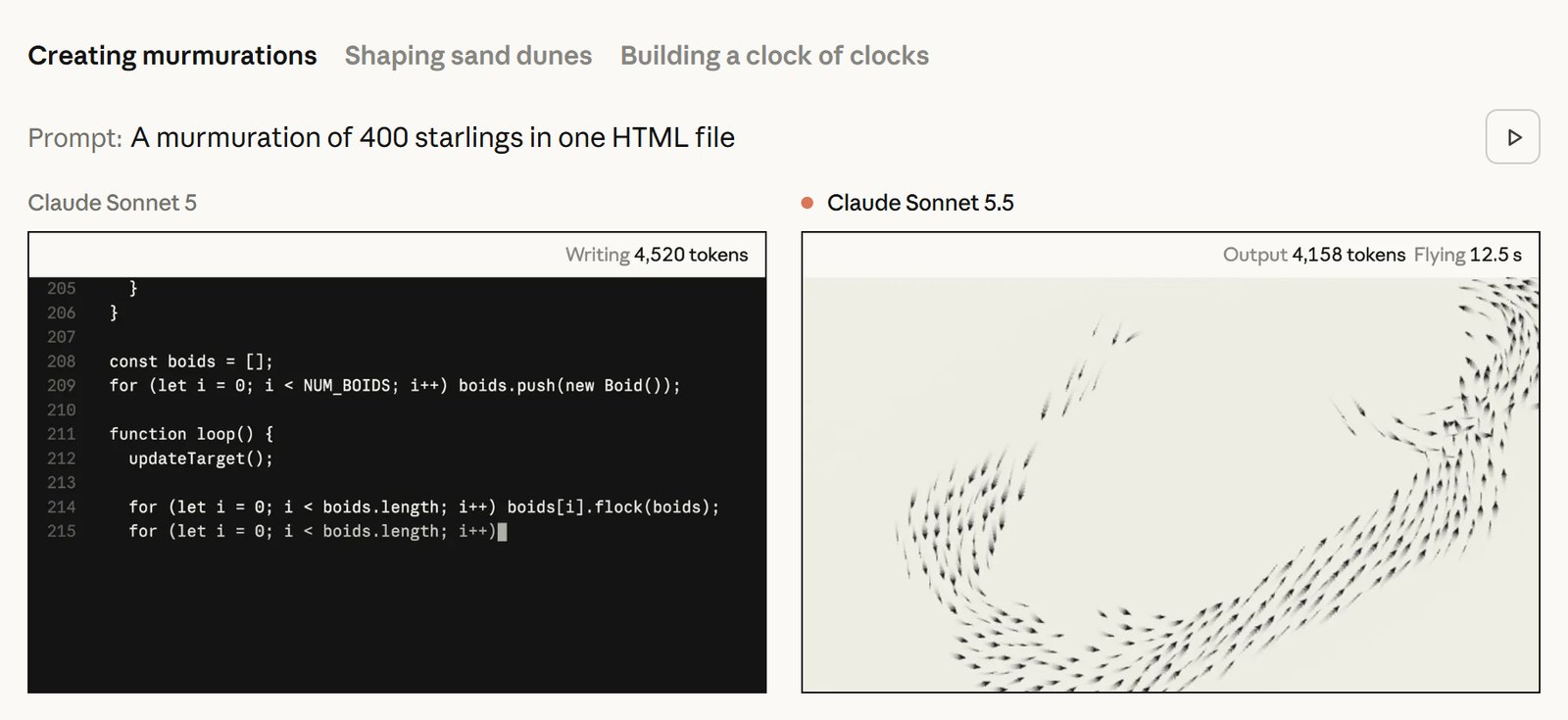
In that frame, Sonnet 5 has written 4,520 tokens and is still going. Sonnet 5.5 finished with 4,158 output tokens, and its flock has been on screen for 12.5 seconds. It needed fewer tokens for the whole job than its predecessor had written so far, which is where the per-task saving comes from.
Claude Sonnet 5.5 benchmarks vs Sonnet 5, Opus 5.5 and GPT-6 Sol
This is Anthropic’s official table. GPT-6 Sol is the fair comparison from OpenAI, since its list price per token is the same:
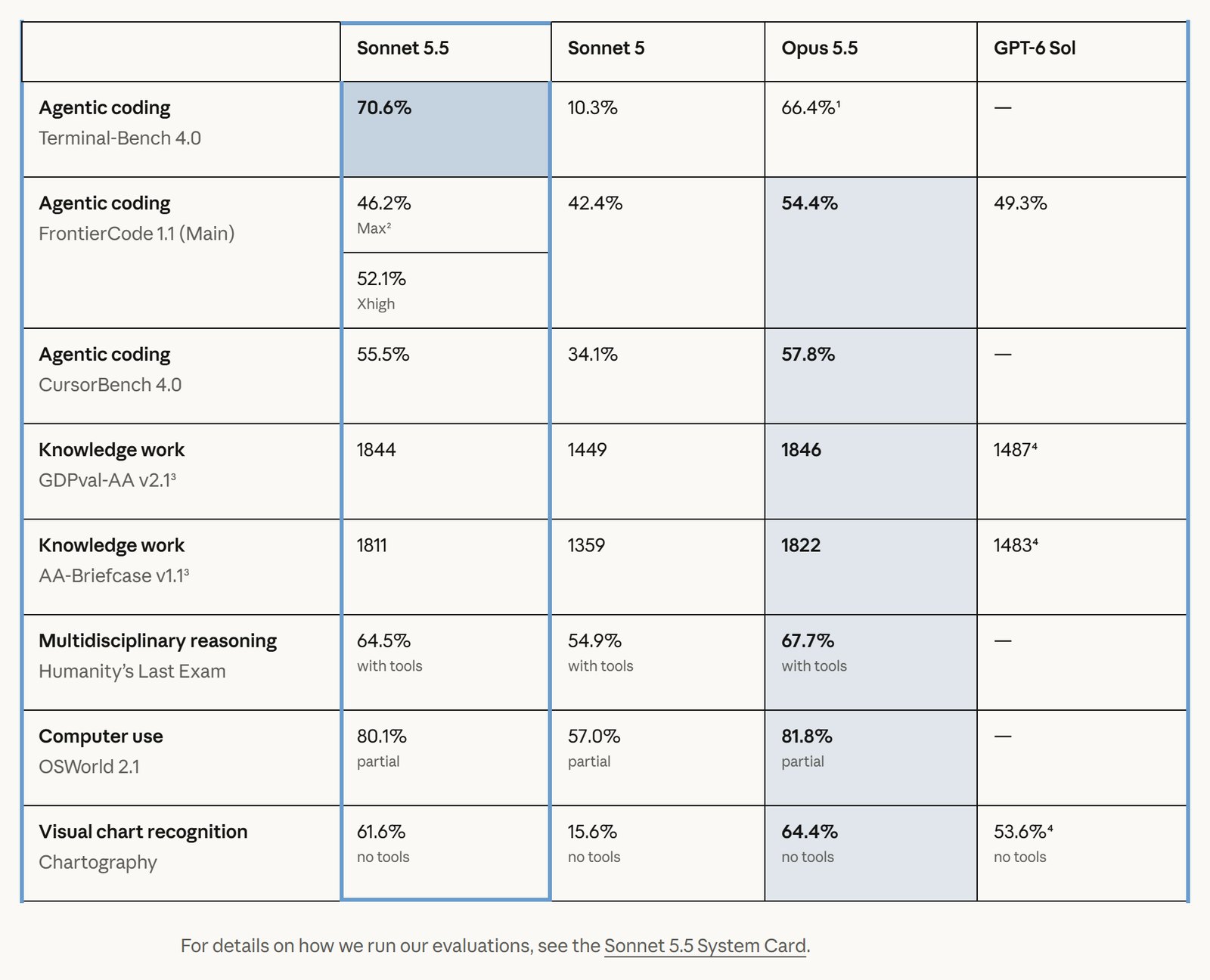
The same numbers as text:
| Benchmark | Sonnet 5.5 | Sonnet 5 | Opus 5.5 | GPT-6 Sol |
|---|---|---|---|---|
| Terminal-Bench 4.0 (agentic coding) | 70.6% | 10.3% | 66.4% | — |
| FrontierCode 1.1 Main (agentic coding) | 52.1% at xhigh, 46.2% at max | 42.4% | 54.4% | 49.3% |
| CursorBench 4.0 (agentic coding) | 55.5% | 34.1% | 57.8% | — |
| GDPval-AA v2.1 (knowledge work, Elo) | 1844 | 1449 | 1846 | 1487 |
| AA-Briefcase v1.1 (long-horizon knowledge work, Elo) | 1811 | 1359 | 1822 | 1483 |
| Humanity’s Last Exam, with tools | 64.5% | 54.9% | 67.7% | — |
| OSWorld 2.1 (computer use, partial) | 80.1% | 57.0% | 81.8% | — |
| Chartography, no tools | 61.6% | 15.6% | 64.4% | 53.6% |
Sonnet 5.5 beats Sonnet 5 on every row. The Terminal-Bench jump, from 10.3% to 70.6%, even puts it above Opus 5.5’s 66.4% (Opus 5.5 ran at xhigh, its highest score). Everywhere else Opus 5.5 stays ahead, by two points on GDPval-AA and about two on CursorBench.
Anthropic adds its own caveat. Benchmarks capture one facet of a model, and in its testing and that of outside testers, Opus 5.5 “remains clearly stronger at complex, open-ended work requiring sustained judgment.” Three footnotes also change how to read the table:
- FrontierCode checks whether a code change could be merged without human edits, and it penalizes out-of-scope changes even when they are good ones. At max effort, Sonnet 5.5 ran Claude Code’s code-review skill more often, which splits a review across many subagents. In two cases Cognition examined, that led to a timeout or to edits beyond the task, hence the lower score at max than at xhigh.
- Artificial Analysis ran GDPval-AA and AA-Briefcase on a pre-release deployment that had a bug affecting requests with structured outputs. Anthropic expects the effect, if any, to be small and to understate Sonnet 5.5. The bug has since been fixed.
- OpenAI recently fixed a bug that degraded image understanding in GPT-6 Sol, so its GDPval-AA, AA-Briefcase and Chartography figures may predate the fix. Artificial Analysis does not expect major impacts, and Anthropic’s internal testing suggests the Chartography score was not affected.
The FrontierCode chart shows the first footnote, plus something more useful for whoever pays the bill:
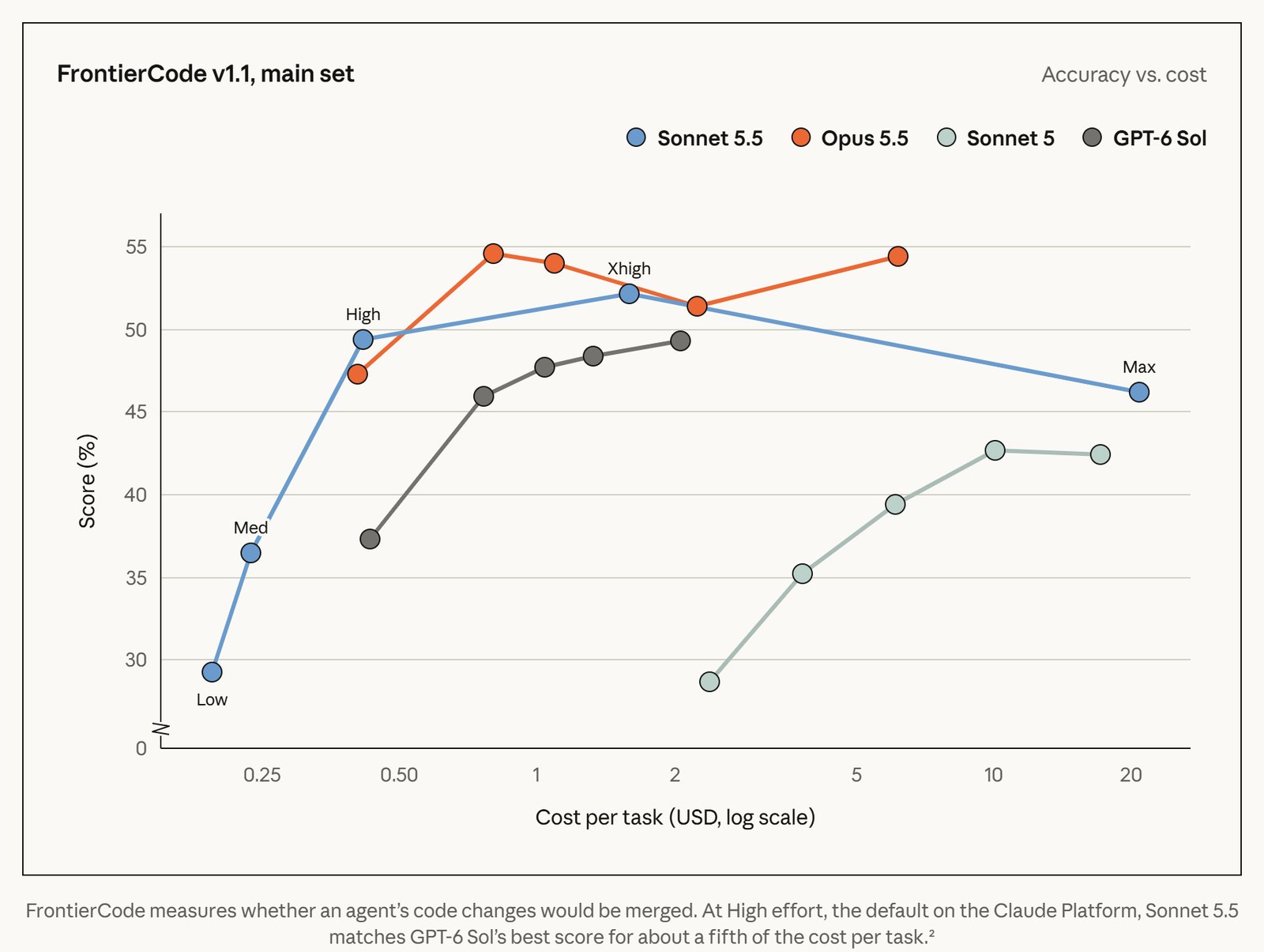
At high effort, the Claude Platform default, Sonnet 5.5 matches GPT-6 Sol’s best FrontierCode score for about a fifth of the cost per task. At that same setting it scores 10 points above Sonnet 5, at about one fifteenth of the cost.
Claude Sonnet 5.5 pricing and the real cost per task
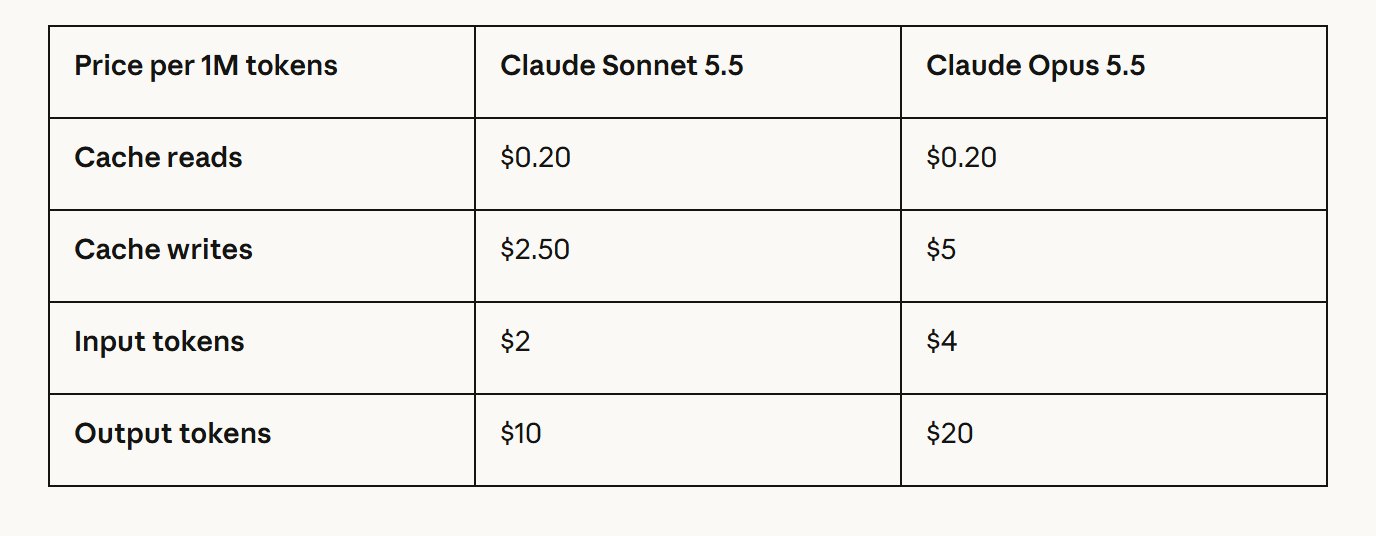
| Per 1M tokens | Sonnet 5.5 | Opus 5.5 |
|---|---|---|
| Input | $2 | $4 |
| Output | $10 | $20 |
| Cache reads | $0.20 | $0.20 |
| Cache writes (5 min) | $2.50 | $5 |
| Cache writes (1 hour) | $4 | $8 |
| Batch API input / output | $1 / $5 | $2 / $10 |
Every rate matches Sonnet 5, and the full 1M context is billed at the standard rate. Sonnet 5’s $2/$10 started as introductory pricing through August 31; Anthropic has since made it standard and dropped a scheduled increase to $3/$15. Fast mode is not part of this launch: Anthropic’s pricing page lists it only for Opus models.
“Half the price of Opus” holds for input and output, but not for cache reads, which cost $0.20 on both. That matters, because agent loops read far more cached context than they write. Take the same made-up session I used in my Opus 5.5 breakdown, not a real customer bill: 2M cache-read tokens, 200K fresh input tokens and 100K output tokens.
- Opus 5.5: 2 × $0.20 + 0.2 × $4 + 0.1 × $20 = $0.40 + $0.80 + $2.00 = $3.20
- Sonnet 5.5: 2 × $0.20 + 0.2 × $2 + 0.1 × $10 = $0.40 + $0.40 + $1.00 = $1.80
That is about 44% less at the same token count, not 50%. GPT-6 Sol lands on exactly $1.80 too, since OpenAI prices it at $2 input, $0.20 cached input and $10 output. The gap opens on long requests: OpenAI’s long-context rate for Sol is $4 input and $15 output, while Anthropic keeps the whole 1M window at the standard rate.
The other half of the saving is token count, which is what Anthropic’s cost charts show. Each point is an effort level, and the closer a point sits to the top left, the more capability you get per dollar:
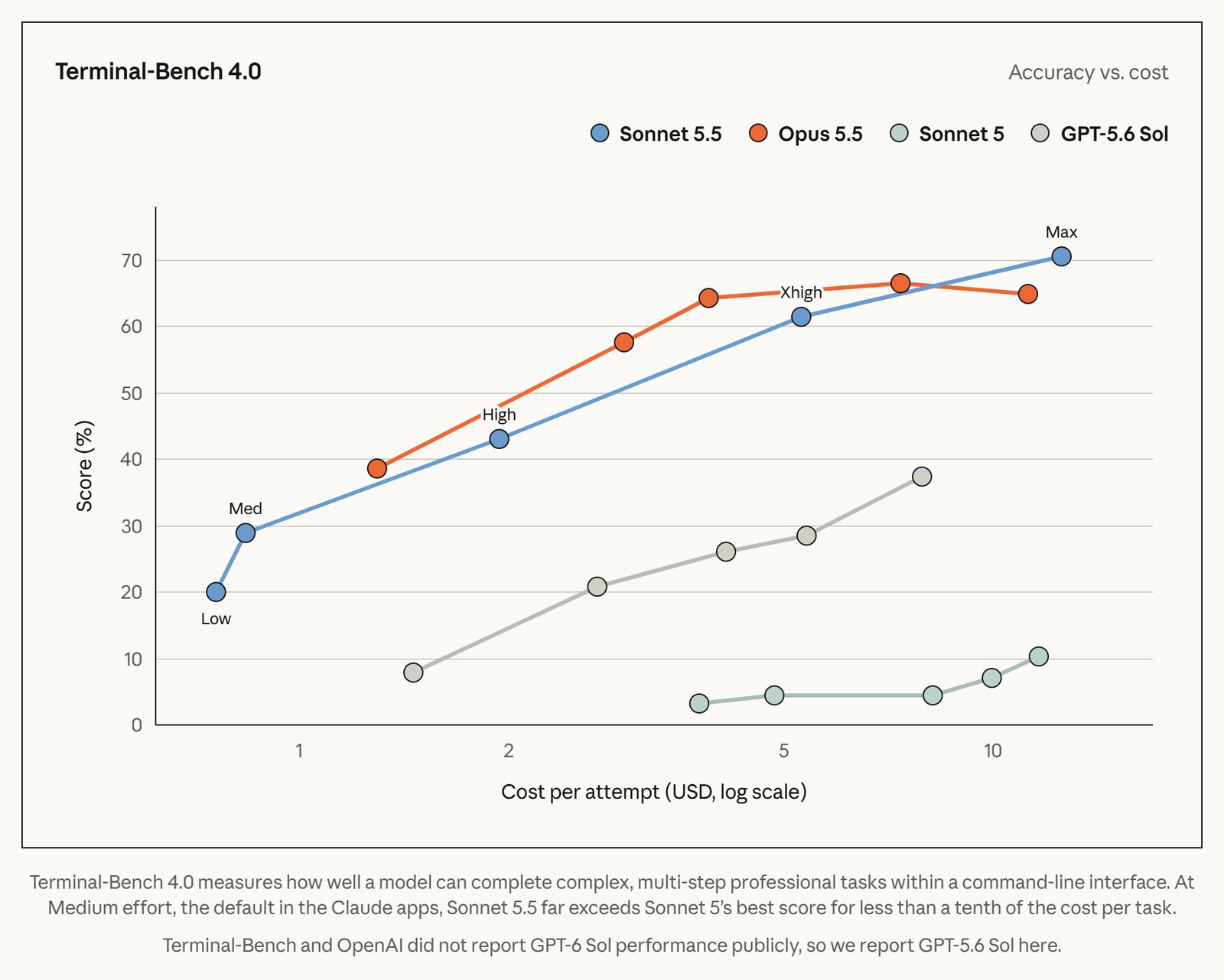
At medium effort, the default in the Claude apps, Sonnet 5.5 beats Sonnet 5’s best Terminal-Bench score for less than a tenth of the cost per task. Now look at where the headline 70.6% sits. It is the rightmost point on the chart, at max effort, and it costs more per attempt than any Opus 5.5 point, while the medium-effort point sits around 30%. The big number is real; it is just the most expensive setting, not what the app runs by default. GPT-6 Sol is missing here because its Terminal-Bench score was never published, so Anthropic plotted GPT-5.6 Sol instead.
Anthropic’s own summary is fair: Sonnet 5.5 complements Opus 5.5 best at lower effort settings, where it costs less per task, and at higher settings it can perform comparably at a similar cost.
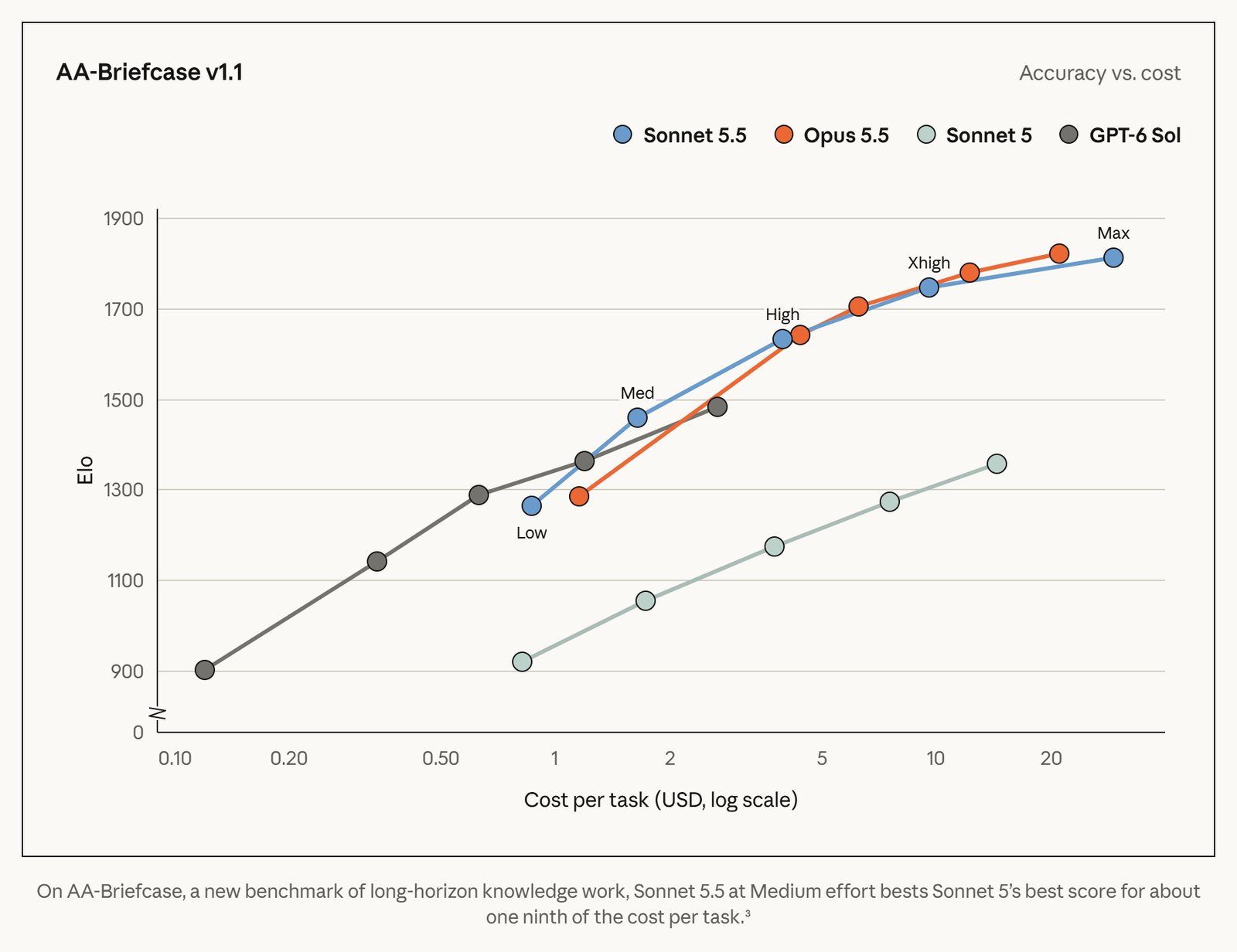
On AA-Briefcase, a new benchmark of long-horizon knowledge work, Sonnet 5.5 at medium effort beats Sonnet 5’s best score for about a ninth of the cost per task.
Customer reports on the launch page point the same way. Balyasny Asset Management says that across 2,441 finance tasks it used about 121K tokens per answer, where Sonnet 5 used 497K. Box says it was more accurate, 2.4x faster and used 12% fewer total tokens. Base44 says that across 118 real app builds its apps scored level with Opus 5, in 3.6 iterations per build on average against 7.7 for Opus 5. Lovable reports a third fewer tool calls and roughly half the shell runs to finish a task.
Claude Sonnet 5.5 breaking changes when you migrate from Sonnet 5
Swapping the model ID is not always enough. Anthropic’s “What’s new” page lists five breaking changes for code already running on Sonnet 5, and most of them return a 400 invalid_request_error:
- Turning thinking off with
{"type": "disabled"}is rejected. Send{"type": "between_tools"}instead: it turns off up-front thinking and still returns short progress updates between tool calls. It works atlow,mediumandhigheffort only;xhighandmaxneed adaptive thinking. Manualbudget_tokensare rejected as well. - Forced tool use is gone. A
tool_choiceofanyortoolreturns an error, so keepauto, setstrict: trueon the tool for schema-valid input, and say in the prompt when the tool applies. - Thinking blocks are tied to the model and the conversation. Sonnet 5.5 reads blocks from Sonnet 5, Opus 4.8, Haiku 4.5 and earlier models, but not from Opus 5, Opus 5.5, Fable or Mythos, and no other model reads Sonnet 5.5’s blocks. Unreadable blocks are dropped without an error. On accounts created on or after August 31, 2026, replaying a block after editing anything before it (system prompt, tools or an earlier message) returns a 400, so keep conversations append-only.
- The
computer_20251124computer use tool is rejected on the Claude API and Google Cloud. Move to thecomputer_toolset_20260801toolset; Amazon Bedrock still accepts the old tool. - The advisor tool (beta) no longer accepts Opus 4.8, Opus 4.7 or Sonnet 5 as the advisor when Sonnet 5.5 is the executor. Opus 5.5, Opus 5, Fable, Mythos or Sonnet 5.5 itself work, and the advice comes back encrypted as an
advisor_redacted_resultblock.
A minimal before and after in Python:
# Worked on Sonnet 5, returns a 400 on Sonnet 5.5
client.messages.create(
    model="claude-sonnet-5",
    thinking={"type": "disabled"},
    tool_choice={"type": "tool", "name": "extract_invoice"},
    ...
)

# Sonnet 5.5
client.messages.create(
    model="claude-sonnet-5-5",
    thinking={"type": "between_tools"},  # high effort or below
    output_config={"effort": "medium"},  # set it; the API default is high
    tool_choice={"type": "auto"},        # plus "strict": True on the tool
    ...
)
One change fails silently. Between tool calls, notes longer than a sentence or two now come back as progress-update thinking blocks, and at the default display: "omitted" their text is empty. A UI that streams those notes to users simply goes quiet. Set a display value when you use adaptive thinking, or use between_tools, which returns the text.
Effort needs a look too. The API default is high, while the Claude apps and Claude Code run at medium; Opus 5.5 is the other way round, with medium as its API default. The docs say effort levels were recalibrated, so the same level no longer produces the same amount of thinking it did on Sonnet 5. Their suggested starting points are medium for well-specified agentic coding, high for harder or longer tasks, and medium or low for chat and latency-sensitive work.
A few changes help without any code. The tokenizer is the same as Sonnet 5’s, so token counts don’t move. The minimum cacheable prompt drops to 512 tokens from 1,024. And per-message effort (beta), mid-conversation system messages and mid-conversation tool changes (beta) now work, none of which Sonnet 5 supports.
Safety: the Sonnet 5 fallback and account-bound thinking
Sonnet 5.5 is the first Sonnet to ship with cyber safeguards and fallbacks like those on Opus 5.5, because Anthropic rates its cyber capabilities as comparable to Opus 5’s. Finding and fixing bugs in your own code is fine; higher-risk cybersecurity tasks visibly fall back to Sonnet 5. Anthropic says cyberdefenders will soon be able to apply to an expanded Cyber Verification Program for tiered access on Sonnet 5.5, Opus 5.5 and Claude Mythos models.
On the API, a declined request returns HTTP 200 with stop_reason: "refusal" and a stop_details category: cyber, bio, frontier_llm, reasoning_extraction or general_harms. Server-side fallback (fallbacks: "default", in beta on the Claude API) retries cyber and frontier_llm declines on Sonnet 5, but not the other three, so handle those yourself.
Biology safeguards are the same as Sonnet 5’s. Most research, education and clinical work is unaffected, though some microbiology and virology requests may be flagged in error, and vetted organizations can apply to the Life Sciences Verification Program.
Against distillation, where attackers use thousands of fake accounts to extract a model’s capabilities, Sonnet 5.5 is the first Sonnet with safety classifiers that block reasoning extraction. It also extends preserved thinking: its thinking blocks only work in the account that produced them, or in a linked one. Most developers won’t notice, but if you move conversations between accounts, or switch accounts mid-session in Claude Code, the earlier thinking is dropped.
On alignment, Anthropic says Sonnet 5.5 improves on or matches Sonnet 5 on most measures of its automated behavioral audit, which runs roughly 1,850 scenarios. In newer containment evaluations it comes close to Opus 5.5 in how rarely it tries to escape its sandbox, and it is the least likely of Anthropic’s models to probe the limits of its containers. Opus 5.5 still does slightly better across the full audit. Anthropic found no evidence that Sonnet 5.5 pursues goals that conflict with the user’s, while noting that no set of evaluations catches every failure. Zero data retention is available, as with Opus 5.5.
Sonnet 5.5 vs Opus 5.5: which should you use?
My take, not Anthropic’s. If you use Claude in the app for everyday work (summarizing a document, drafting an email, fixing a function), you will rarely need Opus 5.5, and you will feel the speed on the first reply. If you build on the API and watch cost, Sonnet 5.5 is the model I would test first for scoped agentic coding and for documents, slides and spreadsheets.
For long, open-ended work, like designing a system from scratch, Anthropic itself says Opus 5.5 is clearly stronger. One tester describes a split worth copying: Kevin Ngo of Creator says he would feel confident letting Sonnet 5.5 implement a game once Opus 5.5 has set the architecture. The advisor tool gets you close to that on the API, with Sonnet 5.5 as the executor consulting Opus 5.5.
Don’t default to max effort, either. The FrontierCode footnote shows max scoring lower on tightly scoped changes because the model kept reaching for a skill that fans out to many subagents. Heavy skills help big jobs and can hurt small ones.
And if you’re weighing GPT-6 Sol at the same price, Anthropic’s table puts Sonnet 5.5 ahead on GDPval-AA, AA-Briefcase and Chartography, and on FrontierCode ahead at xhigh but behind at max. Those are one company’s numbers about a rival, some from before OpenAI’s image fix, so run both on your own work. I laid out Sol’s pricing and tiers in my GPT-6 Sol and Luna explainer.
Frequently asked questions
When was Claude Sonnet 5.5 released?
Anthropic released Claude Sonnet 5.5 on September 28, 2026. It went live the same day in the Claude apps and Claude Code, and on the Claude API, Amazon Bedrock, Google Cloud, Microsoft Foundry and Claude Platform on AWS. Claude Haiku 5.5 is due in the coming weeks.
How much does Claude Sonnet 5.5 cost?
$2 per million input tokens, $10 per million output tokens and $0.20 per million cache reads, the same as Sonnet 5. The Batch API brings input and output down to $1 and $5.
Is Claude Sonnet 5.5 better than Opus 5.5?
Not overall. In Anthropic’s table it beats Opus 5.5 only on Terminal-Bench 4.0, at max effort, and trails by a few points everywhere else. Anthropic says Opus 5.5 remains clearly stronger at complex, open-ended work; Sonnet 5.5 is faster and half the price per token.
What is the difference between Claude Sonnet 5.5 and Sonnet 5?
Same price, higher scores on every benchmark in Anthropic’s table, output more than 30% faster, and fewer tokens per task. For developers, thinking is switched off with between_tools instead of disabled, forced tool use is gone, and thinking blocks are bound to the model, the conversation and the account.
Is Claude Sonnet 5.5 better than GPT-6 Sol?
On the four benchmarks where Anthropic lists both, Sonnet 5.5 leads on three and splits FrontierCode depending on effort. Both cost $2 input and $10 output per million tokens, but Sol’s long-context rate is higher, and some of its listed scores may predate an OpenAI bug fix.
What is the Claude Sonnet 5.5 context window?
1M tokens, billed at the standard rate across the whole window, with up to 128K output tokens per request (300K on the Batch API with a beta header).